 By
By 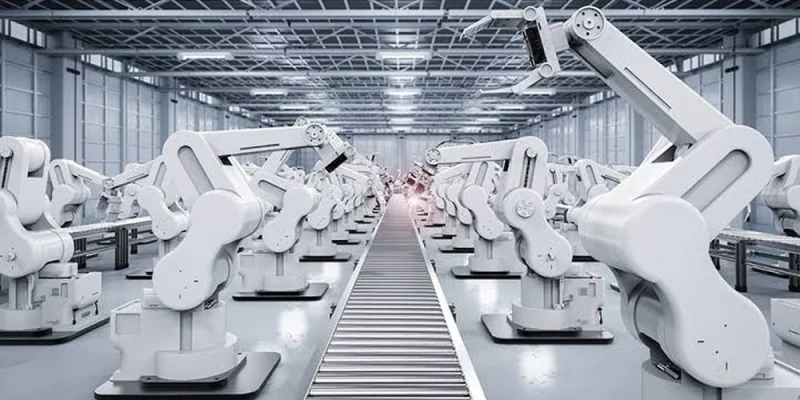
Industrial robots have traditionally been designed around predictable environments. A robot receives a sequence of instructions, repeats the same movements and performs well as long as the surrounding process remains stable. This approach is highly effective in mass production, where parts arrive in the same position and products can remain unchanged for years. It becomes less attractive, however, when manufacturers deal with short production runs, frequent changeovers and variations that cannot all be anticipated during initial programming.
That challenge is pushing industrial robotics toward a more software-driven model. Instead of treating every robot cell as a unique programming project, manufacturers are beginning to look at platforms that separate application logic from the low-level instructions of individual robots.
Why traditional automation struggles with variation
Conventional robot programming works best when engineers can define nearly every condition in advance. The robot follows fixed paths, expects parts in specific locations and responds to predefined signals. When those assumptions remain valid, the system can be extremely reliable.
High-mix manufacturing creates a different environment. Parts may change several times during one shift, workpieces can arrive slightly out of position, and operators may need to launch new jobs without waiting for a robotics specialist. Even relatively small deviations can therefore generate downtime or require manual intervention.
This does not mean traditional programming is obsolete. Highly stable production lines still benefit from deterministic, carefully engineered automation. The problem appears when the cost of repeatedly modifying that automation becomes too high compared with the value of the production run.
Software can separate the task from the robot brand
One emerging approach is to describe the manufacturing task at a higher level and let software translate that intent into robot behaviour. Instead of programming every movement separately, the system manages functions such as part detection, movement planning, task sequencing and production monitoring.
Platforms such as Trener.ai are being developed around this idea. Trener Robotics describes Acteris as a software layer for industrial robots that combines physical AI, robot skills and application control, with current compatibility including ABB, Universal Robots and FANUC.
The distinction between architecture and compatibility is important. A platform can be designed to be independent of any single robot brand without automatically supporting every robot currently available. Actual compatibility still depends on validated robot models, controllers and interfaces.
What changes for operators?
Traditional robotic cells often depend heavily on specialists who understand the programming environment of a particular robot manufacturer. Software-driven systems attempt to move some of that complexity away from day-to-day production.
An operator may instead work with job parameters, production instructions or a conversational interface. The underlying software then handles more of the translation between the task and the robot. Trener states that Acteris can use conversational input for job creation and manages robot behaviour through reusable skills and runtime software.
This does not eliminate engineering. Grippers still have to suit the workpiece, fixtures must be appropriate, and the safety of the complete robotic application must be assessed. Software can reduce programming effort, but it cannot compensate for a badly designed physical process.
Machine tending shows why flexibility matters
CNC machine tending is a useful example because the basic process is simple: pick a raw component, load the machine, wait for machining to finish and remove the completed part. The difficulty in high-mix workshops is that the part may change repeatedly during the day.
If every change requires substantial reprogramming, automation may spend too much time being configured rather than producing. A software layer that can reuse common machine-tending functions while changing part-specific parameters can make the same robot more practical across multiple jobs.
Trener currently presents machine tending as the primary application for Acteris, while also developing the platform around broader reusable robotic skills.
Adaptive software is not a universal replacement
The move toward software-defined robotics should not be interpreted as a reason to rebuild every existing automated line. Fixed automation remains highly efficient where production is stable and predictable.
The strongest case for adaptive software appears where change itself is the problem. High product variety, frequent redeployment and dependence on specialist programming all create costs that a more flexible software layer may reduce.
For manufacturers, the relevant question is therefore not whether software-defined robotics is more advanced than traditional automation. It is whether the production environment changes often enough for adaptability to have measurable operational value.



Comments